

Introduction
Digital transformation is often talked about in terms of technology; AI, automation, ERP, cloud migration. These are the tools shaping enterprise strategies and driving headlines. But as we look ahead to 2026, it’s becoming increasingly clear that technology alone is not enough. The organisations set to thrive will be those that understand transformation runs deeper than systems and software. At its core, digital transformation is a human journey, one shaped by leadership, culture, and inclusion.
According to McKinsey research, we can already see that around 90% of organisations are undertaking digital transformation initiatives as of 2024 and 2025, and the pace of change is only intensifying. By 2026, we can expect technologies to be more intelligent and autonomous, with AI woven into everyday decision-making, and automation handling processes at a scale once thought impossible. These shifts hold immense promise, but they also raise vital questions. Who will lead these changes? How will teams adapt? And how can we ensure the benefits are shared across the organisation?
The answers lie in how we prepare and empower people. Culture and inclusion are rooted in the infrastructure that makes transformation possible.
The Tech Landscape in 2026
By 2026, many technologies considered innovative today will simply be standard. AI will be embedded across operations, supporting everything from supply chain forecasting to personalised finance insights. ERP systems will become more autonomous, guiding decision-making, optimising workflows, and recommending actions without human prompting. Cloud adoption will be nearly universal, and automation will continue to reshape how we work.
These advancements open the door to efficiency and scalability. But technology alone can’t unlock those benefits, and success will depend on whether organisations are culturally ready to evolve and whether their people feel supported and involved in that journey.
The Human Factor
Even the smartest platforms can underperform in a disengaged or disconnected environment. When employees don’t feel equipped or supported during change, resistance builds. But when the culture is inclusive and grounded in trust, new ideas and tools take root more easily.
Leadership will play a critical role in this.
People look to leaders for clarity and inspiration especially during times of disruption. When leaders communicate with transparency and champion growth, teams are more willing to embrace new ways of working. That doesn’t happen with top-down rollouts, it happens through:
• Collaboration
• Empathy
• Investment in people
Equally, the broader culture shapes how people respond to innovation. In workplaces where learning is encouraged, risk is accepted, and feedback is valued, transformation becomes part of the organisational mindset.
These are the kinds of environments where ideas flourish, adoption accelerates, and technology earns its place.
And while inclusion has long been seen as an ethical imperative, its impact on transformation outcomes is becoming undeniable. Diverse teams approach challenges differently. They ask different questions. They surface blind spots and bring perspectives that homogenous teams can miss. In the context of AI and automation, inclusion is a necessity.
Inclusion as Innovation
In fact, inclusive transformation teams may be better equipped to build systems that work for more people as they’re more likely to:
• Spot usability gaps
• Foresee unintended consequences
• Create solutions that reflect the full spectrum of workforce needs
As AI begins to shape strategic decisions, the risk of bias grows if the teams behind it lack representation. Similarly, ERP systems and automated processes must reflect the real-life challenges and workflows of the people who use them. This means including voices from across the organisation such as different roles, experiences, and perspectives in their design and deployment.
Moreover, inclusion builds resilience: when employees see themselves reflected in transformation teams, they’re more likely to trust the change, engage with it, and contribute to its success. And when companies demonstrate that inclusion is embedded, they can develop loyalty and energy that technology alone can’t manufacture.
Looking Ahead: What Will Set Businesses Apart?
By 2026, the divide won’t be between those who have the latest AI tools and those who don’t. It will be between organisations that are culturally ready to adapt and those that aren’t. We’re already seeing signs of this shift and those standing out are:
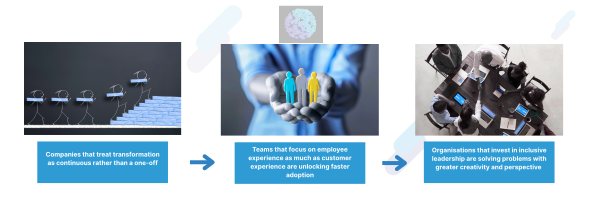
The thread running through all of this is trust. Technology doesn’t build trust, people do. And in a world where every business is undergoing some form of digital reinvention, trust will be one of the most valuable currencies.
What Leaders Can Do Now
To lead successful transformation in 2026, organisations need to prepare their people. That starts with leadership. To prepare for this future, leaders should start today by:
• Developing emotional intelligence – They need to create space for new voices, support upskilling, and guide their teams with clarity and confidence.
• Building diverse teams reflecting the business and customer base – That means including a wide range of perspectives in everything aspect of the business. Change is more likely to stick when people feel ownership over it and that ownership comes from being included.
• Prioritising continuous learning – Digital transformation is a mindset. Whether it’s embracing experimentation, rewarding collaboration, or fostering cross-functional thinking, the goal is to make adaptability a habit, not a reaction.
Conclusion
By 2026, digital transformation will be smarter, faster, and more integrated into daily business life. AI and ERP systems will make decisions at scale. Automation will reduce complexity. And the pressure to innovate will keep rising. But the real measure of transformation success won’t be what software is in place, but how empowered people are to use it. The businesses that succeed will be those that:
✔️ Lead with culture
✔️ Build with inclusion
✔️ Put people at the heart of every system they design
Technology will keep evolving, but in 2026 and beyond, leadership, culture, and inclusion will remain the foundation of real transformation.
If you’re an SAP partner planning events or campaigns in 2026, embracing the human side of digital transformation can elevate your results. The strongest leads come from content that showcases technology whilst also highlighting the stories, voices, and experiences that truly connect.
As an SAP Partner Benefits Catalog–listed agency, we’re uniquely positioned to support your event strategy with co-funded campaign options, tailored assets, and demand-gen programs that drive measurable results.
Want to hear more about our PBC offerings? Click Here
Let’s talk about how your next event or campaign can attract attention and drive action.
