As SAP moves into 2026, partners are finding that funding is increasingly tied to impact.
Recent changes in how SAP awards Development Funds (DF) indicates that the partners who are best positioned to secure development funds are those who can clearly demonstrate how their plans support SAP’s transformation priorities, while delivering measurable customer outcomes.
With ECC to S/4HANA migration entering its final critical phase, SAP is prioritising partners who can drive momentum at scale with long-term value in mind.
This means business plans must evolve beyond traditional implementation models and instead tell a compelling transformation story to stand out and maximise funding.
So, here’s what we would do to maximise funding.
Start with a Cloud-First, Clean Core Foundation
At the heart of SAP’s 2026 strategy is cloud adoption, underpinned by a clean core. Business plans that tend to stand out are ones that clearly outline how technical debt will be reduced and have systems that are kept upgrade ready.
If partners are struggling with how to do this, a good first step could be to anchor their plans around cloud-first SAP S/4HANA strategy, making sure to showcase how they will help customers transition from on-premise environments into scalable cloud models.
Increasingly, SAP is seeing strong demand for hybrid or “bluefield” approaches, meaning customers can retain critical data and processes while modernising their core systems.
Building this into your roadmap shows you understand what the market actually needs.
Make AI and BTP Central to the Value Story
If you want your business plan to look strong, we recommend demonstrating how AI will be embedded into customer transformations in a way that delivers tangible benefits such as improved decision-making or productivity gains.
Partners should articulate how SAP Joule, Business AI, and the SAP Business Technology Platform can be used together to extend functionality without touching the core. Plans that include partner-developed applications, intelligent extensions, or analytics built on BTP show long-term thinking and align closely with SAP’s platform strategy.
So simply, show how AI will be used in customer transformations, and what difference it will actually make.
Lead with Outcomes
Next, we find that SAP funding decisions increasingly favour partners who can clearly connect delivery to outcomes. Rather than focusing purely on technical scope, business plans should describe the commercial and operational value customers will achieve.
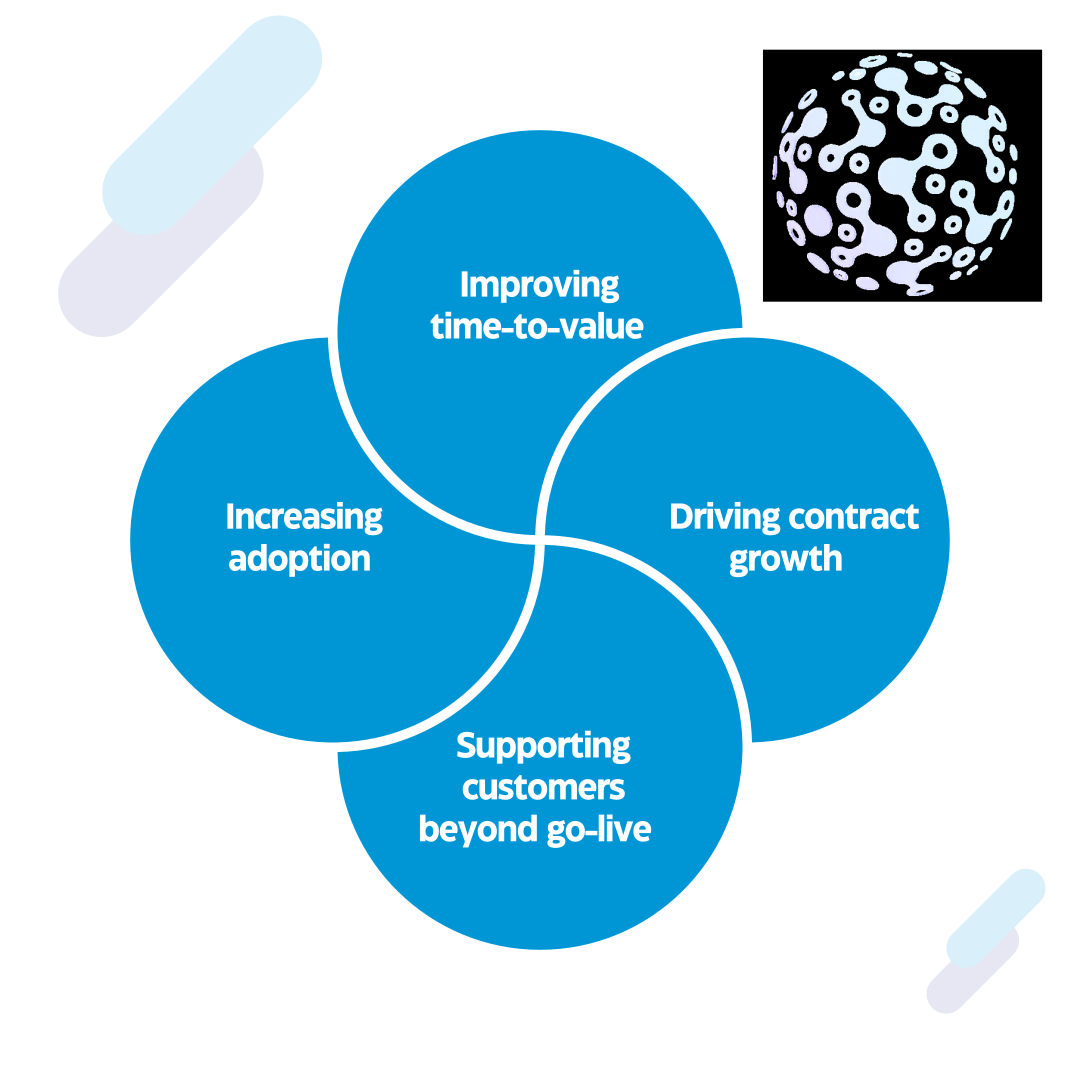
Clear post-go-live plans show long-term impact, which SAP values when funding partners.
Differentiate Through Focus and Expertise
Following this, generic transformation stories are definitely becoming less compelling. Partners who clearly define where they specialise, (industry, solution area, or use case) tend to be more competitive for funding.
Showing packaged solutions or real use cases helps demonstrate how your approach can be repeated and scaled.
Sustainability is also gaining prominence, with growing interest in solutions that support ESG reporting and green transformation initiatives. Having documented success stories published through SAP channels can further strengthen your credibility.
Demonstrate Operational Readiness to Execute at Scale
Finally, SAP wants confidence that funded initiatives can be delivered effectively. Your Business plans are likely to be favoured if you reflect ongoing investment in skills, certifications, and governance.
Leading partners are formalising Centres of Excellence to ensure consistency, and best practice across projects.
Collaboration also plays a role here. Working with specialist partners or agencies who understand the SAP ecosystem can help turn funding into real pipeline, without pulling delivery teams away from their core work
Where demand generation fits into 2026 funding plans
Beyond delivery and transformation capability, demand generation is emerging as a key driver of SAP funding in 2026.
In fact, around 80% of development funds in 2026 are expected to be awarded to demand generation. That shift reflects a clear priority: partners build pipeline and support SAP’s go-to-market motion are more likely to secure funding.
This means business plans need to show how you will drive awareness and engagement.
Strong plans clearly outline a mix of demand generation activity, such as:
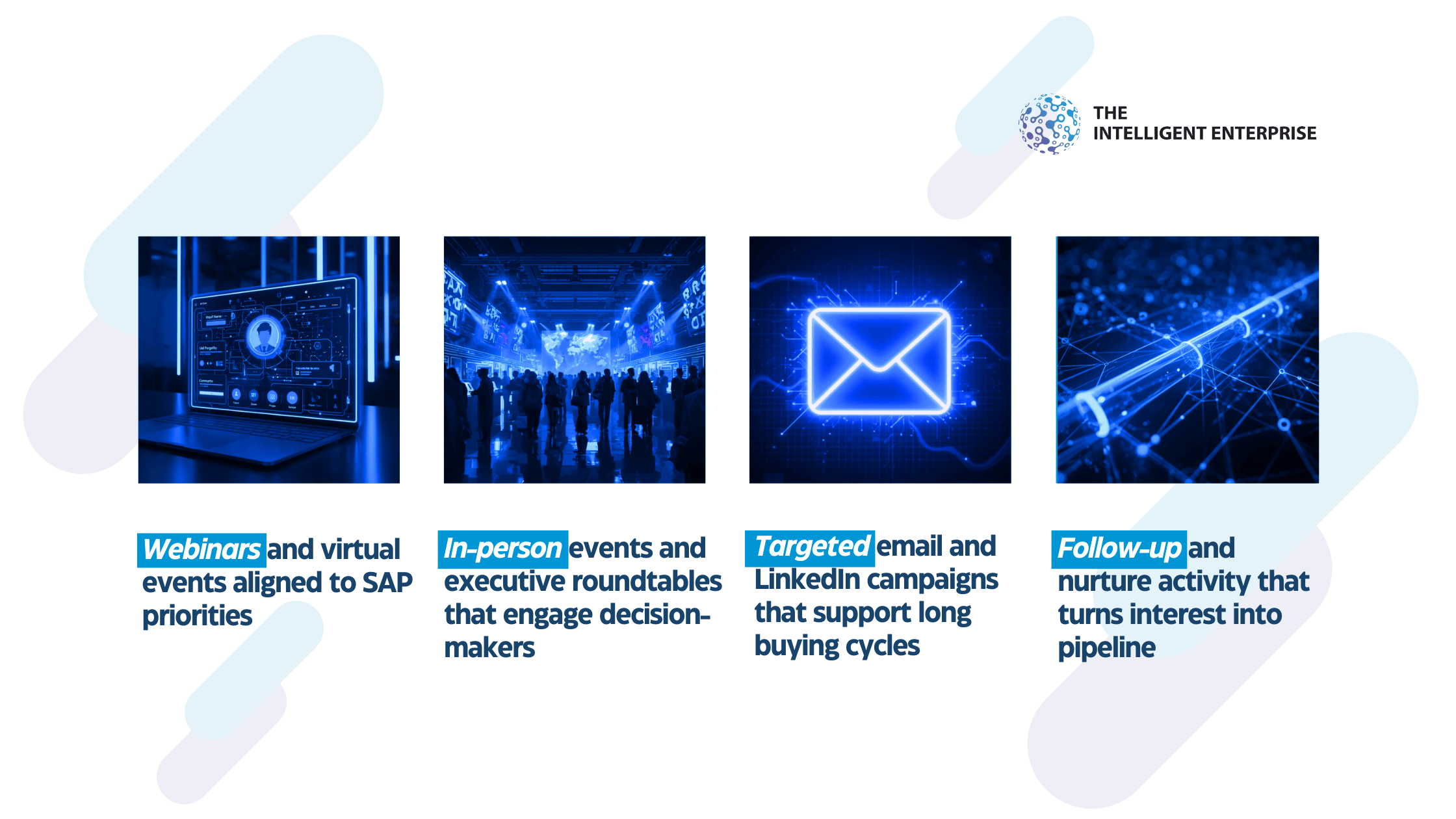
What SAP is looking for here is a clear, joined-up approach that shows how demand generation activity will support pipeline creation and align with SAP campaigns and messaging in order to drive measurable outcomes.
Including demand generation in the business plan shows SAP how funding will be used to build momentum in the market.
Bringing It All Together
Ultimately, the strongest 2026 business plans tell a clear story:
- Alignment with SAP’s strategic direction
- A credible path to customer value
- The ability to execute at pace
- Clear evidence of repeatability and scale
- A realistic plan for sustained growth beyond go-live
- A clear approach to building demand and pipeline in the market
In summary, we recommend focusing on clean core, cloud adoption, embedded AI, and measurable outcomes.
These priorities should be brought together in a well-structured, realistic plan, supported by a clear demand generation strategy.
By showing how you will deliver transformation and create demand for it, SAP partners can significantly improve their chances of securing funding and accelerating growth in the year ahead.
Want to strengthen your partner strategy in 2026?
Explore how to maximise your SAP Development Funds through the Partner Benefits Catalog.
Or let’s talk about how your next event or campaign can attract attention and drive action
